

The AI Slop Problem in Communications: When Everything Starts Coming Out the Same

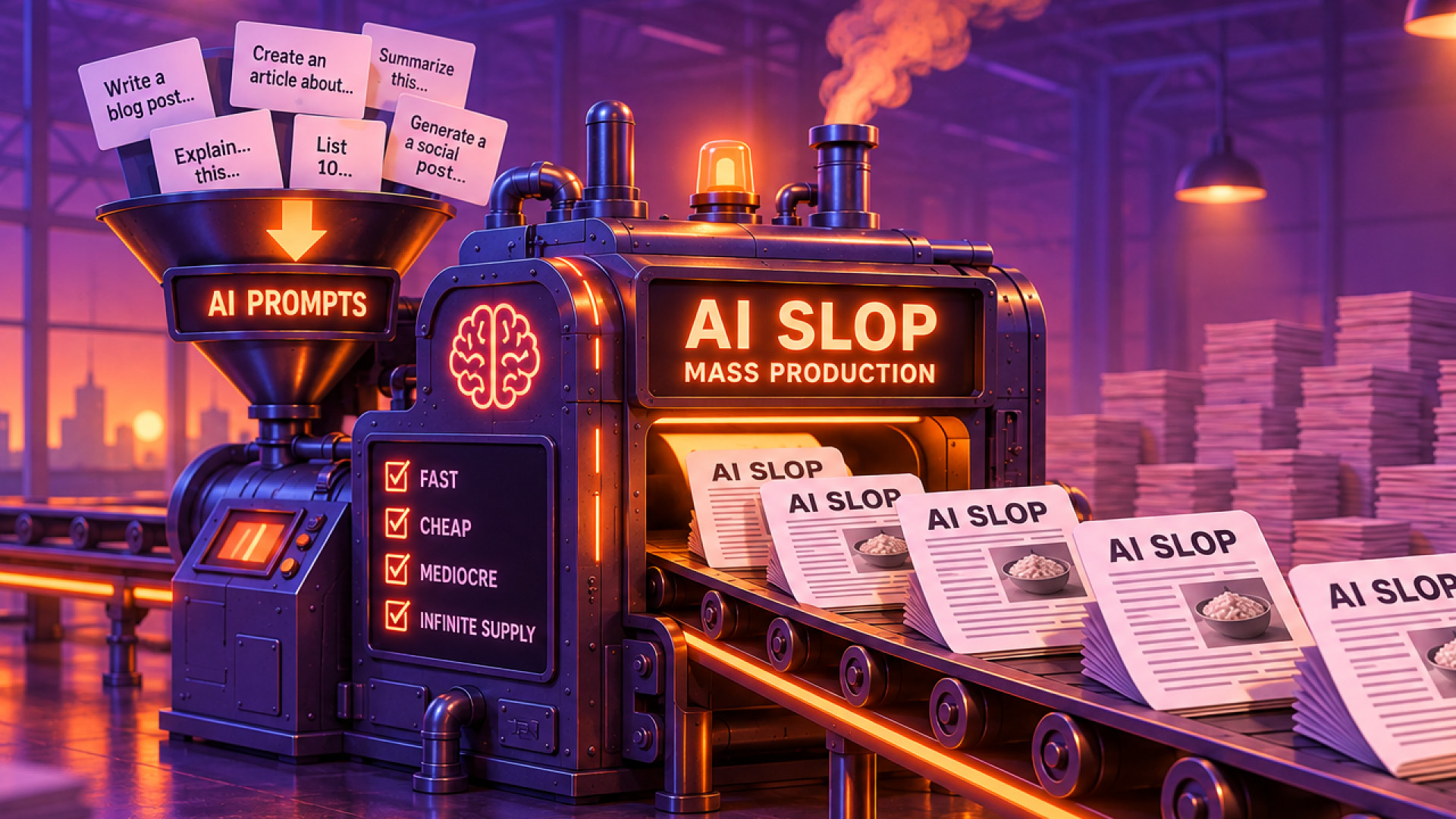
We have all seen it, especially in the last year: a seemingly endless stream of ads, articles, images, posts, and videos that feel strangely familiar. That is the new phenomenon of "AI slop."
AI slop refers to high-volume, low-effort, AI-generated content that prioritizes speed, scale, and engagement over originality, accuracy, usefulness, or meaning. Most importantly, it is devoid of human judgment.
The irony is that generative AI can be an extraordinarily useful tool. It can help us get past the blank page, shave hours off research, organize thoughts, identify new angles, and move faster when time is tight.
For communicators, especially in the Beltway, that kind of support is invaluable. But faster is not the same as better. And more content is not the same as more communication.
The Entropy Problem in Communications
I hold a degree in integrated science and technology, though after college I transitioned into communications. One scientific concept that stayed with me is entropy. Without turning this into an in-depth physics lecture: simply put, maximum entropy is the state where all usable energy is distributed evenly across a system, gradients vanish, and the system reaches complete thermodynamic equilibrium—rendering all regions indistinguishable.
In communications, when the effort to produce content falls, volume surges, and quantity quickly overtakes quality. Feeds become crowded, and search results get noisier. It becomes harder to tell what is original and what is AI-generated. As a result, content becomes an indistinguishable blur.
The risk is not simply that there will be more bad content online. The bigger risk is sameness. If every organization relies on the same tools, draws from the same publicly available information, and accepts the output without meaningful human direction, their messaging begins to homogenize.
Human First, Human Last
I recently discussed the phrase "human first, human last" in the context of AI, and I believe it remains the right standard.
Human first means bringing the essential inputs before a prompt is ever written:
- A clear strategy and communications objective
- A deep understanding of the client, the issue, the audience, and the moment
- Defined voice, values, proof points, and sensitivities
- Original thinking about what is actually worth saying
Human last means owning the final output:
- Fact-checking every claim
- Vetting for accuracy, context, and unintended implications
- Removing generic language and empty filler
- Infusing judgment, specificity, experience, and a genuine point of view
- Ensuring the final product sounds like the person or organization behind it
AI does not inherently understand stakeholder relationships, a client's institutional history, political or reputational sensitivities, or the real-world consequences of a botched message. It cannot know whether an otherwise clever line will land poorly with a community, confuse an audience, or undermine trust built over decades.
That responsibility stays with people.
Gabrielle Massoud is a Communications Director at Story Strategies Group.

 By Samantha Pepi

 By Chuck Sundin